
Turning Trash into Treasure: Solving the Organic Waste Dilemma with Compost Tanks
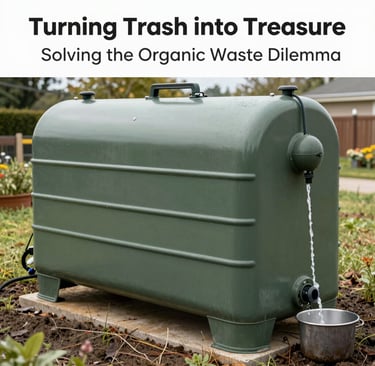
Turning Trash into Treasure: Solving the Organic Waste Dilemma with Compost Tanks
For decades, industrial facilities have viewed organic waste—food scraps, agricultural residue, and biosolids—as a necessary evil. It’s the stuff you pay to get rid of. It creates mess, attracts pests, and generates complaints. In short, it’s a liability.
But what if that "trash" wasn't trash at all?
In 2026, the most forward-thinking companies are flipping the script. They are using Industrial Compost Tanks to transform their organic waste streams from a financial drain into a valuable, revenue-generating asset. This is the core of the circular economy: Turning Trash into Treasure.
The Dilemma: When Waste Becomes a Business Risk
Traditional waste management follows a linear "take-make-dispose" model. For organic waste, this typically means:
Collecting scraps in smelly bins.
Paying a hauler to transport it (using fossil fuels).
Paying a landfill or incinerator to take it off your hands.
This model is broken. It exposes your business to:
Rising Tipping Fees: Landfill costs increase every year.
Regulatory Fines: Stricter EPA and local organic waste bans.
Brand Reputation Damage: Social media posts showing overflowing dumpsters.
The dilemma is clear: How do you stop the bleeding and turn this liability into an opportunity?
The Solution: Industrial Compost Tanks as a Profit Center
An Industrial Compost Tank (or In-Vessel Composting System) is a sealed, aerobic bioreactor. Instead of burying or burning waste, it accelerates nature’s decomposition process under controlled conditions to create a high-value end product: Stable, Nutrient-Rich Compost.
Here’s how "Trash" becomes "Treasure":
Step 1: Input (The "Trash")
Your raw organic waste enters the tank. This includes fruit/vegetable pulp, spent grains, manure, food processing rejects, and even some paper products. Inside the sealed vessel, forced aeration and microbial activity begin breaking it down.
Step 2: Transformation (The Magic)
Over 7–15 days, the system maintains optimal temperature (131–158°F / 55–70°C), moisture, and oxygen levels. This high-heat environment eliminates pathogens and weed seeds, ensuring a safe, sanitized product.
Step 3: Output (The "Treasure")
The result is a dark, earthy-smelling, biologically stable compost. This isn't just dirt—it's a certified soil amendment rich in organic matter and beneficial microbes.
Quantifying the "Treasure": From Cost Center to Revenue Stream
Let’s break down the financial shift. Instead of writing checks for waste removal, you start generating value.
Metric
Old Model (Landfill)
New Model (Compost Tank)
Waste Hauling Cost
$-5,000/month
$-500/month (Residual waste only)
Tipping Fees
$-3,000/month
$0
Compost Sales/Use
$0
+$1,500/month (Estimated value or direct sale)
Fertilizer Savings
$0
+$800/month (Using compost on-site)
Net Monthly Impact
-$8,000
+$1,800 (Positive Cash Flow)
Figures are illustrative estimates based on a mid-sized food processing plant.
How You Monetize the Treasure:
Direct Sales: Sell certified compost to local nurseries, landscapers, or big-box stores.
On-Site Use: Apply it to corporate landscaping, golf courses, or agricultural land to cut fertilizer costs.
Carbon Credits: Participate in emerging carbon markets for avoided methane emissions (Scope 3 reductions).
Marketing Premium: Use your "Zero Waste to Landfill" status to attract eco-conscious B2B clients.
Beyond the Balance Sheet: Intangible Treasures
The financial benefits are clear, but the strategic advantages are just as valuable:
Enhanced Brand Equity: Consumers and partners prefer companies that are part of the solution, not the pollution.
Supply Chain Resilience: You are less vulnerable to disruptions in the waste hauling industry.
Employee Pride: Staff are more engaged when working for a company with visible sustainability initiatives.
Who Can Turn Their Trash into Treasure?
This model works for any facility generating significant organic waste:
Breweries & Distilleries: Spent grains and yeast.
Fruit & Vegetable Processors: Peels, pulp, and trimmings.
Dairy & Livestock Farms: Manure mixed with bedding.
Supermarkets & Distribution Centers: Unsold produce and floral waste.
Stop Paying to Throw Away Gold
Your organic waste isn't garbage. It's a biological asset trapped in a linear system. An Industrial Compost Tank is the key to unlocking its value.
Don't just manage waste. Monetize it.
Ready to calculate the ROI for your facility?
👉 [Download Our "Treasure Map": The Complete Guide to Compost Monetization]
or [Schedule a Free Consultation with Our Engineers]