
Overwhelmed by Waste Volume? Scale Your Composting Capacity with Industrial Tanks
Overwhelmed by Waste Volume? Scale Your Composting Capacity with Industrial Tanks
You did everything right. You started with a small-scale composting operation, proved the concept, and demand took off. Maybe your municipality expanded its organic waste collection program, or your food processing client doubled their production line. Suddenly, the system that once worked perfectly is maxed out.
Your windrows are too long. Your crews are turning piles seven days a week. Your storage bays are overflowing. You’re facing a classic scaling bottleneck.
When your waste volume outpaces your processing capacity, you face tough choices: expand your land footprint (expensive and often impossible), buy more tractors (high CapEx and OpEx), or turn waste away (lost revenue and unhappy clients).
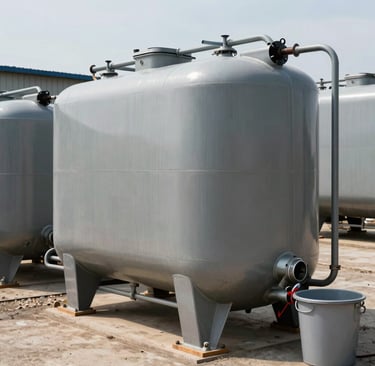
There is a better way. Industrial Compost Tanks (In-Vessel Systems) are specifically engineered to decouple composting capacity from land area, allowing you to scale vertically and automate your way to higher throughput.
The Scaling Problem with Traditional Composting
Open windrow and static pile methods are inherently limited by physics and geography.
Limitation
Impact on Scaling
Land Footprint
Doubling capacity often requires doubling land area, which is rarely available.
Weather Dependency
Rain and cold halt decomposition, causing bottlenecks in winter or wet seasons.
Labor Intensity
Requires constant heavy machinery operation (turning, moving), increasing labor costs as volume grows.
Process Variability
Hard to maintain consistent temperature/moisture across acres of piles, leading to inconsistent product quality.
As volume increases, these problems don't just add up—they multiply.
The Solution: Vertical Scaling with Industrial Tanks
Unlike horizontal windrows, Industrial Compost Tanks operate as batch or continuous-flow reactors. This fundamentally changes the math on scalability.
1. Higher Throughput in a Smaller Footprint
A single industrial tank system can process the equivalent of 3–5 acres of windrows in a fraction of the space.
Vertical Design: Stacking processes or using tall cylindrical tanks maximizes cubic volume, not just square meters.
Modular Units: Need to double capacity? You don't need to buy a new farm. Simply add another parallel tank module to your existing system.
2. Automation Reduces Labor Bottlenecks
Scaling with tractors means hiring more drivers. Scaling with tanks means leveraging automation.
PLC Controls: Operators monitor multiple tanks from a single control room.
Automated Turning/Aeration: Internal augers or forced aeration systems run on timers, not on manpower.
Result: Process 10 tons/day with 2 operators, or 50 tons/day with the same team.
3. Consistent, High-Speed Processing (7–15 Day Cycles)
While windrows take 60–120 days, industrial tanks achieve full decomposition in as little as one week.
Accelerated Biology: Precise control over temperature (55–70°C), moisture (50–60%), and oxygen (>5%) creates the perfect environment for microbes.
Year-Round Operation: Enclosed systems are immune to rain and freezing temperatures, eliminating seasonal slowdowns.
A Scalability Case Study: The Math of Growth
Let's compare two hypothetical 5-year growth plans for a commercial composter starting with 5 tons/day capacity.
Metric
Scenario A: Windrow Expansion
Scenario B: Industrial Tank Modular Expansion
Year 1 Capacity
5 tons/day
5 tons/day
Year 3 Target
15 tons/day
15 tons/day
Land Required
~15 acres
~2 acres
Equipment Needed
3 Tractors, 3 Drivers
1 Loader, 1 Control Room Tech
Scalability Constraint
Physical land availability
Electrical/Utility capacity
Product Consistency
Variable (weather dependent)
High (controlled environment)
Scenario B demonstrates how industrial tanks remove the primary constraint of land and labor, allowing your business to scale linearly with demand.
Who Needs to Scale Now?
This solution is critical for:
Municipalities: Expanding curbside organics collection programs.
Hub & Spoke Models: Centralized facilities receiving waste from multiple smaller generators.
Large Agricultural Operations: Managing seasonal peaks in manure and crop residue.
Co-composting Facilities: Processing both biosolids and food waste, which requires higher containment standards.
Scale Smart, Not Just Big
Growth should be an opportunity, not a crisis. If you are feeling the strain of increasing waste volumes, expanding horizontally is the most expensive and least efficient option.
Industrial Compost Tanks allow you to scale your capacity while shrinking your footprint and labor costs.
Ready to future-proof your operation?
Don't let infrastructure bottlenecks limit your growth.
👉 [Download Our Capacity Planning Guide for Industrial Composting]
or [Request a Scalability Consultation with Our Engineering Team]